Connect Share & Split Billing (FT-1015.006)
About this document
Scope
This document provides background information as well as a functional description of the Connect Share & Split Billing (FT-1015.006) optional add-on feature.
The described feature is supported from the release version 5.4.2 onward.
This feature is part of the Billing Cycle Management functionality with number FN-1015.
Feature Availability
Feature Version | Available from | Summary of changes |
|---|---|---|
v1 | CMP Release 5.4.2 | Initial release |
Benefits
MAVOCO Connect Share & Split Billing enables mobile network operators to increase revenues while reducing the cost associated with each SIM. Because multiple stakeholders can share the same connectivity – across both B2B and B2C business models, as well as multiple services and multiple tariff plans – the operator can extract more value from every connected asset. This shared model also enhances flexibility and lowers operational costs, as each stakeholder receives a separate bill and OEMs can manage their own services through built-in self-service capabilities. Stakeholders benefit from real-time analytics that provide full transparency into usage and behavior.
For MNOs, Connect Share & Split Billing also supports increased market share. A rapidly growing group of OEMs – including automotive manufacturers, drone producers, sharing-economy providers, and insurance companies – now actively require split billing capabilities, making this feature a strong competitive advantage.
OEMs benefit equally from Connect Share & Split Billing, as they can reduce costs by paying only for their own usage while gaining the flexibility to control consumer services independently. They also have the opportunity to monetize connectivity, especially when Connect Share Pro is combined with MAVOCO’s Reseller add-on capabilities.
Feature overview
Goals
The aim of the Connect Share & Split Billing feature is to give MNOs, OEMs, and partners full flexibility and transparency in managing connectivity on a single SIM. Its primary goal is to enable clear separation of data usage and billing between enterprise (B2B) and consumer (B2C) services, while supporting multi-stakeholder control, accurate cost allocation, and real-time service management, reducing complexity, lowering costs, and unlocking new revenue opportunities.
Out of scope
Technical Prerequisites
This feature requires the following integrations to function as intended:
Packet Core Integration to Gy
Billing Integration

The above prerequisites reflect a typical setup.
Depending on the customer's existing infrastructure, business processes, or regulatory environment, additional integrations or configurations may be necessary to ensure full compatibility and optimal performance.
Functionality of the feature
The Connect Share & Split Billing feature provides a flexible, future-proof solution to one of the biggest challenges in connected mobility. Its Split Billing capability introduces a Multi-Party Connectivity architecture that enables complete separation of traffic and billing domains on a single SIM without compromising flexibility or transparency.
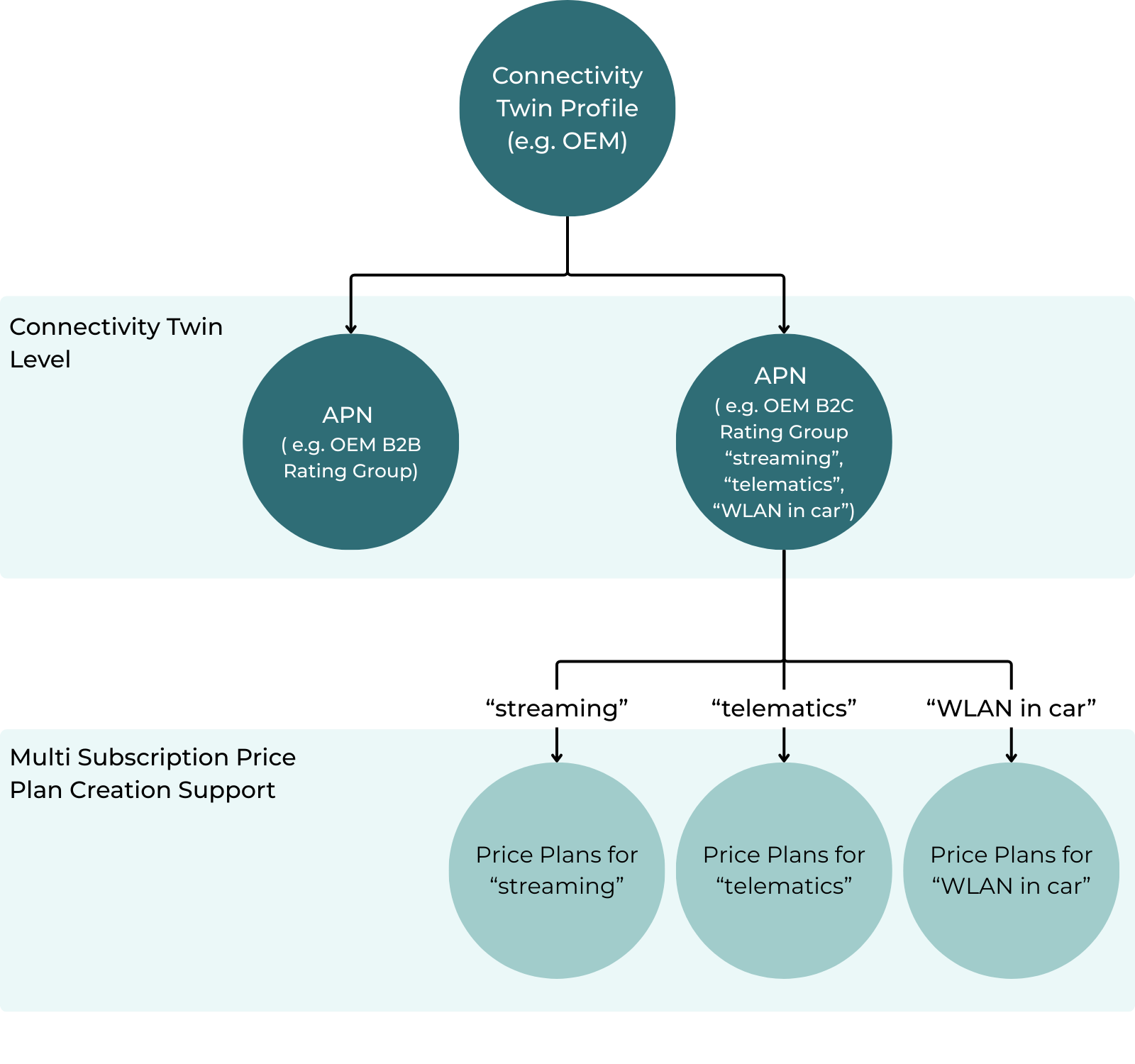
At its core, the solution uses Multi-Party Connectivity Profiles (MPCP) to define logical splits for enterprise (B2B) and consumer (B2C) services. Each split is bound to a specific APN and, where applicable, one or more Rating Groups to ensure precise traffic categorization. This configuration is enforced at the network level through Diameter Gy messages carrying Called-Station-Id (APN) and Rating Groups AVPs, allowing the online charging engine (OUC-A) to validate sessions in real-time against MPC Profiles.
A key component of this architecture is the Virtual SIM Card (vSIM). A vSIM is a logical SIM Profile created alongside the physical SIM to enable Split Billing and multi-subscription services. It allows separate data usage and billing for different parties without requiring multiple physical SIM Cards.

SMS and voice services are restricted to the physical SIM, while data services are distributed across virtual profiles.
Once a Multi-Party Connectivity (MPC) Profile is assigned to a SIM, CMP provisions virtual identifiers, an MPC IMSI, and an MPC ICCID for each split. These identifiers are used internally for rating and reporting, enabling independent lifecycle management for virtual SIMs, without altering the physical SIM’s network identity. This ensures that B2B (enterprise) traffic, such as telematics, remains unaffected when consumer services (B2C) like infotainment are activated or suspended.
Price Plans are tightly coupled with Multi-Party Connectivity (MPC) Profile splits and cannot override APN or Rating Group definitions. MPC Postpaid (Individual, Flex, or Fixed Pool) Price Plans apply to physical SIMs for enterprise (B2B) usage, while MPC Prepaid Individual Price Plans are assigned to virtual SIMs for consumer (B2C) services. Event Data Records (EDRs) reflect both the physical IMSI and the virtual IMSI used for rating, along with Price Plan and subscription details. Quota enforcement is immediate when a Prepaid allowance for a B2C service is exhausted, the grant size is updated to block further usage, and OUC-A returns a Diameter error code to terminate the session, while enterprise connectivity (B2B) continues uninterrupted.
Example
When the free quota in a consumer (B2C) Price Plan is used up, CMP automatically blocks consumer connectivity (e.g., in-car Wi-Fi) while ensuring uninterrupted enterprise (B2B) connectivity (e.g., telematics).
Operational control is provided through the portals of the CMP and APIs, enabling service management and real-time visibility across all connectivity splits. MNOs monitor connectivity through the CSP Portal, while enterprises use a dedicated Enterprise Portal. vSIM-specific dashboards focus on activation, performance, usage, and billing trends, allowing enterprises to track virtual SIM operations separately from physical SIM Card data. The Enterprise Portal includes a Virtual SIM Cards tab that provides detailed records, such as Billing Status, Usage, Session Data, and configuration options, along with actions shared across physical and virtual SIMs, while certain features remain exclusive to physical SIM Cards.
Advanced analytics and CMP reports extended with vSIM details deliver granular insights into traffic patterns, quota consumption, and billing performance.
Billing is handled separately for each stakeholder. B2B (enterprise) and B2C (consumer) services have separate rating and invoicing processes. At the end of each Billing Cycle, the CSP issues invoices for the enterprise Account, excluding any B2C traffic from the B2B invoice. To support reconciliation, the CMP generates detailed reports aligned with the Billing Cycle.